


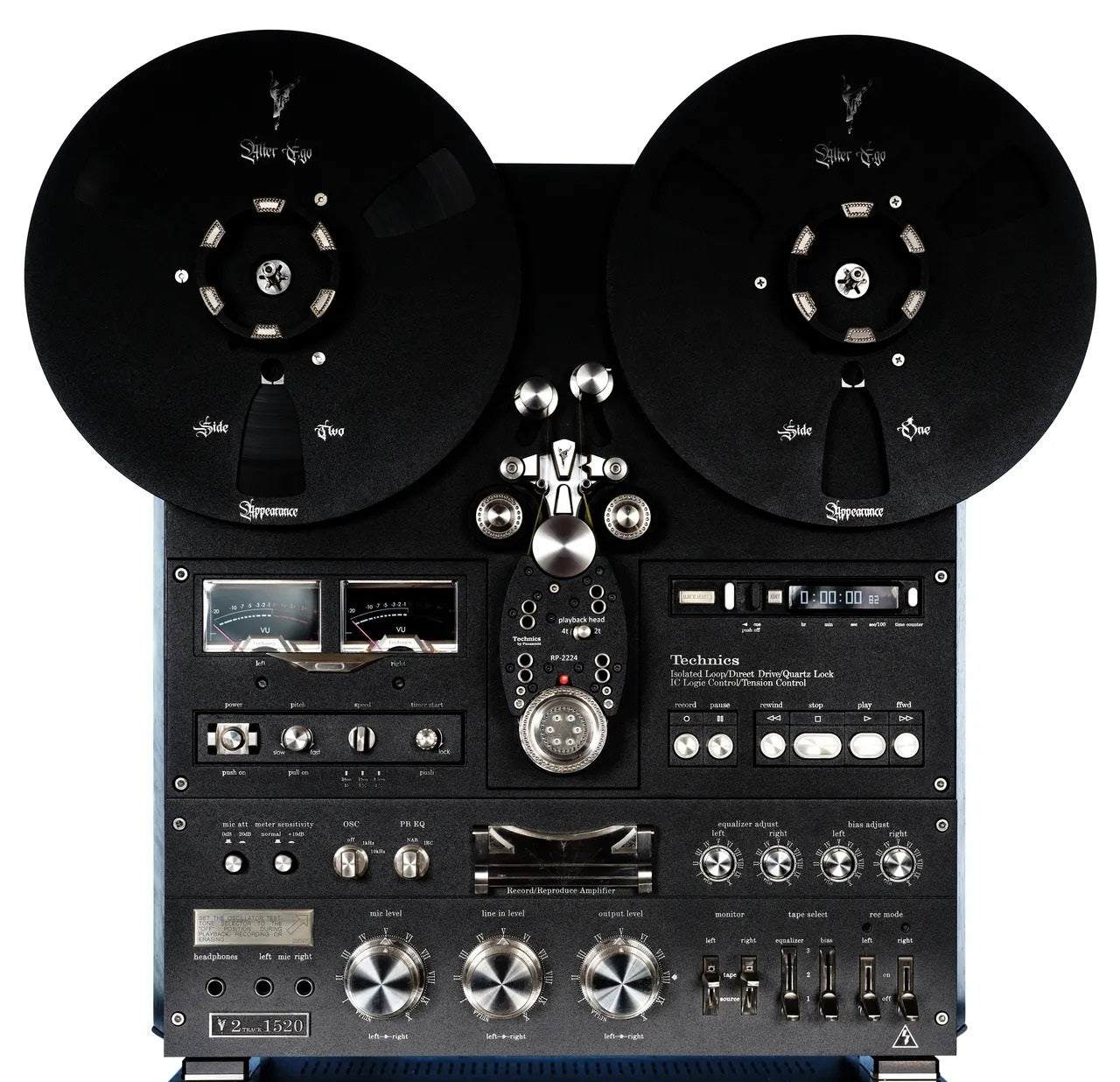









WHICH REEL-TO-REEL TAPE RECORDER DO YOU HAVE RIGHT NOW?
REEL FOR REAL — ONCE UPON A TIME…
 |
Around eight years ago, we had access to something that now feels almost impossible to recreate: an extraordinary private collection of fully restored vintage reel-to-reel tape recorders, prepared not simply to “work,” but to perform as closely as possible to their original factory specification.
These were not machines dragged from storage, quickly cleaned and listed for sale.
They were carefully selected examples that had been serviced, revised, recapped where required, aligned and restored, with attention given to the complete signal path, transport system, heads, controls and cosmetics.
Inside and outside, the objective was simple:
to bring these great analogue machines back to life.
Many were in remarkable cosmetic condition. Heads and tape paths were inspected and maintained, mechanisms serviced and operating parameters checked. Owner and service manuals were also supplied in PDF format.
Today, every machine from that particular collection has been sold.
And looking back at the list reminds us just how extraordinary the golden age of open-reel engineering really was.
THE MACHINES THAT PASSED THROUGH THE COLLECTION
From AKAI, there were machines including the GX-77, GX-400D, GX-400SS, GX-400 Pro, GX-635D/DB, GX-650D and the formidable Pro-1000.
From DENON came professional machines including the DH-610S and DH-710S.
PIONEER was represented by favourites such as the RT-707, RT-901, RT-909, RT-1011 and others.
Then came REVOX, including the legendary A700 and C274.
The SONY collection was particularly memorable: TC-765, TC-766-2, TC-788, TC-7850, TC-850, TC-854 and, incredibly, several examples of the monumental Sony TC-880-2.
Professional machines from TASCAM included the BR-20T, 44-4 and 58.
And what a representation from TEAC: 35-2B, A-3440, A-6600, A-6700, A-7010 GSL, A-7300 variants, F-1, X-10, X-10R, X-1000M, X-1000R and X-2000R.
Finally, there was TECHNICS.
Several examples of the spectacular RS-777, together with the RS-1500 and multiple RS-1700machines.
Looking at that list today feels almost like reading the catalogue of a reel-to-reel museum.
WHY DO THESE MACHINES STILL MATTER?
Because reel-to-reel was never merely another recording format.
At its best, it represented an extraordinary convergence of:
mechanical engineering, precision electronics, industrial design and music reproduction.
Every manufacturer approached the problem differently.
AKAI brought its famous GX glass-and-crystal ferrite heads.
Technics developed the extraordinary Isolated Loop direct-drive transport.
Sony created machines of almost uncompromising mechanical sophistication.
ReVox approached tape recording with the discipline inherited from Studer.
TEAC and TASCAM built machines that became fixtures in home, semi-professional and professional studios.
Pioneer produced some of the most visually iconic open-reel decks ever made.
And that diversity is precisely what makes collecting them so fascinating.
There is no single “best” reel-to-reel recorder.
There are different engineering philosophies.
Different transports.
Different head configurations.
Different EQ standards.
Different tape speeds.
Different sonic personalities.
And different emotional connections.
RESTORATION CHANGES EVERYTHING
Anyone entering the vintage reel-to-reel world today should remember one important point:
model number alone does not determine performance. Condition does.
Two identical machines can sound completely different after forty or fifty years.
A properly serviced machine may have:
— stable tape tension
— accurate tape speed
— correctly aligned heads
— clean switches and contacts
— healthy capacitors
— properly adjusted brakes
— low wow and flutter
— correct record and playback calibration
An untouched example may look magnificent while operating nowhere near its original specification.
That is why proper restoration matters.
A great reel-to-reel machine deserves more than cosmetic polishing.
It deserves to perform as an instrument of precision analogue reproduction.
AND THEN THERE IS THE EXPERIENCE…
Threading a reel.
Selecting 7½ or 15 ips.
Engaging PLAY.
Watching the tension arms settle.
Seeing the VU meters rise.
Watching two large reels rotate almost silently.
And then hearing music emerge with that distinctive sense of body, scale and continuity.
You cannot reproduce that experience with an icon on a touchscreen.
Reel-to-reel listening engages your eyes, your hands and your ears.
It turns listening into a ritual.
Perhaps that is why, decades after these machines were supposedly made obsolete, enthusiasts continue restoring them, collecting them and building entire listening systems around them.
The technology became vintage.
The experience never did.
🎧 NOW IT’S YOUR TURN
We would love to see what the reel-to-reel community is using right now.
👇 Which reel-to-reel tape recorder is currently in your system?
And if you could choose ONE machine from this former collection to own today, which would it be?
AKAI GX-635D?
AKAI Pro-1000?
Pioneer RT-909?
ReVox A700?
Sony TC-880-2?
Tascam BR-20?
TEAC X-2000R?
Technics RS-777?
Technics RS-1500?
Technics RS-1700?
Or is your dream machine something completely different?
📸 Post a photograph of your recorder in the comments. Tell us what model you own, how long you have had it, what speed you normally use and — most importantly — what tape sounds unforgettable on it.
Perhaps some of the machines that passed through this collection eight years ago are still playing music somewhere today.
If one of them is yours, we would especially love to hear from you.
please note: Studio Alchemist NAB Adapters discontinued and not for sale.
REEL FOR REAL.

|
Keeping the Reel-to-Reel Renaissance in Motion.
OpenReelToReel | The Sound of Tape
#OpenReelToReel #ReelToReel #ReelForReal #AnalogAudio #AnalogueAudio #TapeRecorder #MasterTape #15IPS #VintageHiFi #VintageAudio #Technics #ReVox #Studer #Sony #Akai #TEAC #Tascam #Pioneer #Audiophile #HighEndAudio #MagneticTape #TheSoundOfTape
 Пообщайтесь с нами
